


Page 30 - Effetto Performance Tours
P. 30
The art of performing for a local audience — in Italy, in Greece and in the Balkans 30
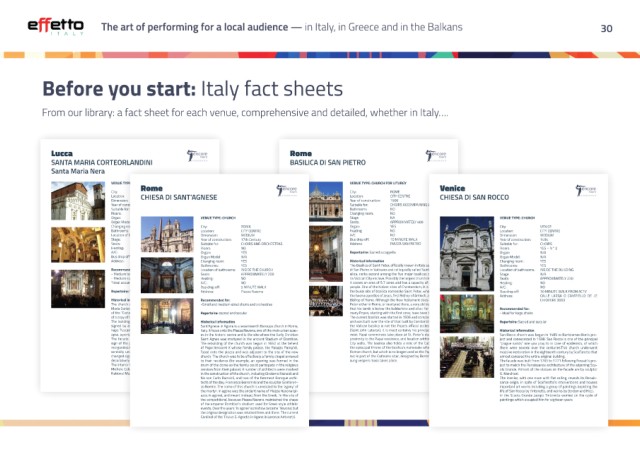
Before you start: Italy fact sheets
From our library: a fact sheet for each venue, comprehensive and detailed, whether in Italy….
LUCCA
LUCCA
LUCCA
Lucca Rome
SANTA MARIA VENUE TYPE: CHURCH ROME
SANTA MARIA CORTEORLANDINI BASILICA DI SAN PIETRO
ROME
SANTA MARIA
VENUE TYPE: CHURCH
SANTA MARIA
CORTEORLANDINI
ROME
VENUE TYPE: CHURCH
CORTEORLANDINI
CORTEORLANDINI
Santa Maria Nera
Santa Maria Nera City: LUCCA BASILICA DI SAN PIETRO VENUE TYPE: CHURCH FOR LITURGY
City:
Santa Maria Nera
LUCCA
City:
LUCCA NTRE
CITY CE
Santa Maria Nera
Location:
BASILICA DI SAN PIETRO
CITY CENTRE
VENUE TYPE: CHURCH FOR LITURGY
Location:
MEDIUM
Location:
Dimension: CITY CENTRE BASILICA DI SAN PIETRO VENUE TYPE: CHURCH FOR LITURGY
MEDIUM
Dimension: City:
MEDIUM
Year of construction:
Dimension: 1188 City: ROME
ROME
1188
Year of construction:
CITY CENTRE
City:
Location:
1188
VENUE TYPE: CHURCH CHOIRS & ORCHESTRAS VENUE TYPE: CHURCH FOR LITURGY
Year of construction:
Suitable for:
ROME
Location:
CITY CENTRE
CHOIRS & ORCHESTRAS
Suitable for:
CHOIRS & ORCHESTRAS
CITY CENTRE
Suitable for: Rome Year of construction 1506 Venice
Year of construction
Location:
YES – N° 3
1506
Risers:
YES – N° 3
Risers:
Year of construction
Suitable for:
N/A
N/A LUCCA
1506 ROME
CHOIRS ACCOMPAINING
Organ:
Suitable for:
Risers: YES – N° 3 City: CHOIRS ACCOMPAINING VENICE
City:
VENICE
Organ:
LITURGY
CHOIRS ACCOMPAINING
Suitable for:
N/A
Organ: CHIESA DI SANT’AGNESE Location: LITURGY CHIESA DI SAN ROCCO
CITY CENTRE
Organ Model:
Location:
N/A CITY CENTRE
N/A
Organ Model:
Bathrooms
LITURGY
N/A
Dimension: YES Year of construction NO 1506 VENICE
YES MEDIUM
Changing room:
Organ Model:
NO
Bathrooms
Changing room:
NO
Changing room:
Bathrooms
Changing room:
NO
Changing room:
Bathrooms: YES Suitable for: NO CHOIRS ACCOMPAINING LITURGY CHIESA DI SAN ROCCO VENUE TYPE: CHURCH
YES
YES 1188
Year of construction:
Bathrooms:
NA
Stage
Changing room:
Bathrooms:
VENUE TYPE: CHURCH
NO
INSIDE THE BUILDING
Stage
Location of bathrooms:
INSIDE THE BUILDING
Suitable for:
CHOIRS & ORCHESTRAS
CHIESA DI SANT’AGNESE
Location of bathrooms:
NA
Seats:
INSIDE THE BUILDING
APPROXIMATELY 400
N/A CHIESA DI SANT’AGNESE
Location of bathrooms:
Stage
Stage: YES CHIESA DI SANT’AGNESE VENUE TYPE: CHURCH Bathrooms NA NO CHIESA DI SAN ROCCO VENUE TYPE: CHURCH
VENUE TYPE: CHURCH
APPROXIMATELY 400
Risers:
Changing room:
CHIESA DI SAN ROCCO
N/A YES – N° 3
NO
Seats:
ROMA
City:
City:
YES
Stage: APPROXIMATELY 200 VENUE TYPE: CHURCH ROMA Organ: APPROXIMATELY 400 City: VENICE
N/A
Seats:
Stage:
Organ:
Seats:
CITY CENTRE
N/A
ROMA
Location:
CITY CENTRE
Location:
Seats:
Organ: APPROXIMATELY 200 City: VENUE TYPE: CHURCH Stage YES NA VENUE TYPE: CHURCH CITY CENTRE
VENICE
City:
APPROXIMATELY 200
Organ:
NO
Seats:
CITY CENTRE
Location:
Heating
Heating:
MEDIUM
YES
NO
Dimension:
Dimension:
MEDIUM
Heating:
Heating
Organ Model: NO N/A Location: MEDIUM Seats: NO APPROXIMATELY 400 City: Location: VENICE CITY CENTRE
17 th Century
NO
Year of construction:
Year of construction:
Dimension:
17 th Century
NO
Heating:
A/C
Heating
NO
A/C:
City:
CHOIRS AND ROMA
CHOIRS AND
NO
A/C: NO Year of construction: 17 th Century Organ: NO YES City: Dimension: MEDIUM
A/C
Changing room:
VENICE
NO YES
Location:
CITY CENTRE
10 MINUTE WALK
Suitable for:
Suitable for:
A/C:
Bus drop off:
ORCHESTRAS
A/C
Dimension:
ORCHESTRAS
NO
Bus drop off:
Year of construction:
YES
10 MINUTE WALK
Bathrooms: 10 MINUTE WALK Suitable for: CHOIRS AND CITY CENTRE Heating 10 MINUTE WALK Location: 1494 MEDIUM
Bus drop off:
NO
Location:
ORCHESTRAS
MEDIUM
CITY CENTRE
Bus drop off:
Dimension:
NO
10 MINUTE WALK
Address:
VIA S. MARIA CORTE
Risers:
Address
NO
Bus drop off:
Risers:
PIAZZA SAN PIETRO
Address:
Suitable for:
CHOIRS
1494
VIA S. MARIA CORTE
Bus drop off:
10 MINUTE WALK
PIAZZA SAN PIETRO
Address
Risers:
Location of bathrooms:
Organ:
Dimension:
Organ:
A/C
MEDIUM
MEDIUM
INSIDE THE BUILDING
YES
NO YES
NO
Year of construction:
Year of construction: 1494
Address:
VIA S. MARIA CORTE
ORLANDINI 10A
Organ Model:
Organ Model:
Risers:
Address
N/A N/A
Year of construction:
ORLANDINI 10A
10 MINUTE WALK
Stage: ORLANDINI 10A Organ: Dimension: YES N/A 17th Century Bus drop off: PIAZZA SAN PIETRO Year of construction: YES – N° 2
N/A
Organ Model:
Suitable for:
1494
CHOIRS
Suitable for:
CHOIRS
YES YES
YES
Changing room:
Changing room:
Organ:
Changing room:
Recommended for:
N/A
Address
YES
YES YES
APPROXIMATELY 200
Repertorire: Sacred a cappella PIAZZA SAN PIETRO
Seats:
Bathrooms:
Suitable for:
CHOIRS
Bathrooms:
CHOIRS AND ORCHESTRAS
Recommended for:
Suitable for:
Bathrooms:
YES – N° 2
Risers:
YES – N° 2
Risers:
Repertorire: Sacred a cappella
Location of bathrooms:
Location of bathrooms:
Recommended for:
- Medium to large sized choirs
INSIDE THE CHURCH
INSIDE THE CHURCH
N/A
Organ Model:
INSIDE THE CHURCH
Seats: Risers:
Risers:
Location of bathrooms:
Heating:
NO
YES – N° 2
- Medium to large sized choirs NO
Organ:
APPROXIMATELY 200
N/A
Repertorire: Sacred a cappella
APPROXIMATELY 200
Seats:
Seats:
- Medium sized orchestras (max 60 instrumentalists)
NO NO
Changing room:
- Medium sized orchestras (max 60 instrumentalists)
YES
Repertorire: Sacred a cappella
N/A
Heating:
A/C: Organ:
NO
Heating:
A/C:
*Ideal acoustics
N/A
- Medium sized orchestras (max 60 instrumentalists)
Organ Model:
Historical information
NO NO
NO
N/A
*Ideal acoustics
Organ Model:
A/C:
A/C:
Bus drop off:
Bathrooms:
10 MINUTE WALK
YES
The Basilica of Saint Peter, officially known in Italy as the Basilica
Organ Model:
5 MINUTE WALK A
*Ideal acoustics
Organ Model:
N/A
5 MINUTE WAN/
The Basilica of Saint Peter, officially known in Italy as the Basilica
5 MINUTE WALK LK
YES
Changing room:
Bus drop off: f:
Historical information
Bus drop off:
Bus drop of
di San Pietro in Vaticano and colloquially called Saint Peter's
- Medium to large sized choirs NO Heating: APPROXIMATELY 200 Historical information Organ: Organ: YES N/A
INSIDE THE BUILDING
Location of bathrooms:
Address:
Address:
The Basilica of Saint Peter, officially known in Italy as the Basilica
di San Pietro in Vaticano and colloquially called Saint Peter's
Historical information
Address:
Repertoire: Sacred & secular. VIA S. MARIA CORTE ORLANDINI 10A
Address:
Piazza Navona YES
Piazza Navona
YES
Piazza Navona
Changing room:
YES
Bathrooms:
Repertoire: Sacred & secular. Changing room: YES Basilica, ranks second among the five major basilicas of Rome and Changing room: YES
di San Pietro in Vaticano and colloquially called Saint Peter's
Basilica, ranks second among the five major basilicas of Rome and
N/A
Repertoire: Sacred & secular.
Stage:
Bathrooms:
Bathrooms:
The Basilica of Saint Peter, officially known in Italy as the Basilica
YES
YES
Bathrooms:
Recommended for:
Recommended for:
Recommended for: its Vatican City enclave. Possibly the largest church in Christianity it Location of bathrooms: INSIDE THE BUILDING
its Vatican City enclave. Possibly the largest church in Christianity it
Basilica, ranks second among the five major basilicas of Rome and
Recommended for:
Historical information -Small and medium sized choirs and INSIDE THE CHURCH covers an area of 5.7 acres and has a capacity of over 60,000 people. Location of bathrooms: APPROXIMATELY 220
Seats:
-Small and medium sized choirs and
INSIDE THE BUILDING
-Small and medium sized choirs and
Location of bathrooms:
di San Pietro in Vaticano and colloquially called Saint Peter’s Ba-
its Vatican City enclave. Possibly the largest church in Christianity it
Stage:
N/A
Historical information orchestras APPROXIMATELY 200 covers an area of 5.7 acres and has a capacity of over 60,000 people. Stage: Location of bathrooms: INSIDE THE BUILDING
One of the holiest sites of Christendom, it is traditionally the burial
Historical information
- Medium to large sized choirs
One of the holiest sites of Christendom, it is traditionally the burial
covers an area of 5.7 acres and has a capacity of over 60,000 people.
The church of Santa Maria Corteorlandini (also known as Santa
Heating:
silica, ranks second among the five major basilicas of Rome and
orchestras
NO
orchestras
N/A
Seats:
site of basilica namesake Saint Peter, who was one of the twelve
The church of Santa Maria Corteorlandini (also known as Santa
Seats:
APPROXIMATELY 220
site of basilica namesake Saint Peter, who was one of the twelve
N/A
One of the holiest sites of Christendom, it is traditionally the burial
Stage:
Maria Corteorlandini a Nera) has two names since it was the site
The church of Santa Maria Corteorlandini (also known as Santa
NO
its Vatican City enclave. Possibly the largest church in Christianity
Seats:
Heating:
- Medium sized orchestras (max 60 instrumentalists)
NO
APPROXIMATELY 220
A/C:
Maria Corteorlandini a Nera) has two names since it was the site
apostles of Jesus, first Bishop of Antioch, and later first Bishop of
Repertoire: sacred and secular
Repertoire: sacred and secular
Repertoire: sacred and secular
NO
apostles of Jesus, first Bishop of Antioch, and later first Bishop of
site of basilica namesake Saint Peter, who was one of the twelve
Heating:
Maria Corteorlandini a Nera) has two names since it was the site
of the "Corte Roladinga" (the Rodalinghi, local lords) and
APPROXIMATELY 220
of the "Corte Roladinga" (the Rodalinghi, local lords) and
*Ideal acoustics
it covers an area of 5.7 acres and has a capacity of over 60,000
Bus drop of
Seats: f:
NO
Heating:
because of a copy of the house and the statue of the black Virgin
Rome. Although the New Testament does not mention Peter either in
apostles of Jesus, first Bishop of Antioch, and later first Bishop of
of the "Corte Roladinga" (the Rodalinghi, local lords) and
NO
Rome, or martyred there, a very old tradition holds that his tomb is
A/C:
because of a copy of the house and the statue of the black Virgin
Historical information
Rome. Although the New Testament does not mention Peter either in
Address:
CALLE LARGA O CAMPIELLO
Rome, or martyred there, a very old tradition holds that his tomb is
people. One of the holiest sites of Christendom, it is traditionally
NO
because of a copy of the house and the statue of the black Virgin
A/C:
of Loreto.
Historical information
NO
5 MINUTE WALK
Historical information
Bus drop off:
Heating:
of Loreto.
Sant'Agnese in Agone is a seventeenth Baroque church
below the baldachino and altar; for this reason, many Popes, starting
Bus drop off:
10 MINUTE WALK FROM ACTV
below the baldachino and altar; for this reason, many Popes, starting
Rome, or martyred there, a very old tradition holds that his tomb is
Sant'Agnese in Agone is a seventeenth Baroque church
Sant'Agnese in Agone is a seventeenth Baroque church
DE LE CHIOVERE 3063
10 MINUTE WALK FROM ACTV
Piazza Navona
Repertoire: Sacred & secular.
in Rome, Italy. It faces onto the Piazza Navona, one of
The building was erected in 1188 in place of an older one, A/C: NO Rome. Although the New Testament does not mention Peter either in Bus drop off: 10 MINUTE WALK FROM ACTV
Address:
the burial site of basilica namesake Saint Peter, who was one of
of Loreto.
A/C:
with the first ones, have been buried there. The current basilica was
NO
The building was erected in 1188 in place of an older one,
with the first ones, have been buried there. The current basilica was
Address:
CALLE LARGA O CAMPIELLO
below the baldachino and altar; for this reason, many Popes, starting
in Rome, Italy. It faces onto the Piazza Navona, one of
in Rome, Italy. It faces onto the Piazza Navona, one of
designed by an unnamed maestro Guido, perhaps Lombard,
the main urban spaces in the historic centre and is the
The building was erected in 1188 in place of an older one,
designed by an unnamed maestro Guido, perhaps Lombard,
the twelve apostles of Jesus, first Bishop of Antioch, and later first
the main urban spaces in the historic centre and is the
the main urban spaces in the historic centre and is the
started in 1506 and completed in 1626, and was built over the site of
with the first ones, have been buried there. The current basilica was
Bus drop off:
10 MINUTE WALK FROM ACTV
DE LE CHIOVERE 3063
designed by an unnamed maestro Guido, perhaps Lombard,
perhaps Tuscan. The medieval church survived in the two site where the Early Christian Saint Agnes was started in 1506 and completed in 1626, and was built over the site of Address: CALLE LARGA O CAMPIELLO DE LE
that built by Constantine. Although the Vatican basilica is not the
site where the Early Christian Saint Agnes was
site where the Early Christian Saint Agnes
Recommended for:
martyred in the ancient Stadium of Domitian. The was
Historical information
perhaps Tuscan. The medieval church survived in the two
Bishop of Rome. Although the New Testament does not mention
that built by Constantine. Although the Vatican basilica is not the
started in 1506 and completed in 1626, and was built over the site of
CHIOVERE 3063
Recommended for:
smaller apse, a portal and the right flank.
perhaps Tuscan. The medieval church survived in the two
Pope's official ecclesiastical seat (Saint John Lateran), it is most
martyred in the ancient Stadium of Domitian. The
martyred in the ancient Stadium of Domitian. The
smaller apse, a portal and the right flank.
CALLE LARGA O CAMPIELLO
- Ideal for large choirs
rebuilding of the church was begun in 1652 at the
Address:
that built by Constantine. Although the Vatican basilica is not the
-Small and medium sized choirs and orchestras
Peter either in Rome, or martyred there, a very old tradition holds
certainly his principal church, as most Papal ceremonies take place at
behest of Pope Innocent X whose family palace, the the
smaller apse, a portal and the right flank.
The facade dates from the late seventeenth century. The design
rebuilding of the church was begun in 1652 at the
Recommended for:
rebuilding of the church was begun in 1652 at
The facade dates from the late seventeenth century. The design
certainly his principal church, as most Papal ceremonies take place at
Pope's official ecclesiastical seat (Saint John Lateran), it is most
behest of Pope Innocent X whose family palace, the
behest of Pope Innocent X whose family palace, the
The church of Santa Maria Corteorlandini (also known as Santa Pope's official ecclesiastical seat (Saint John Lateran), it is most Recommended for: DE LE CHIOVERE 3063
St. Peter's due to its size, proximity to the Papal residence, and
Palazzo Pamphili, faced onto the piazza and was
of the portal is attributed to Domenico Martinelli. A global
- Ideal for large choirs
that his tomb is below the baldachino and altar; for this reason,
The facade dates from the late seventeenth century. The design
Maria Corteorlandini a Nera) has two names since it was the site
Repertoire: Sacred and secular
St. Peter's due to its size, proximity to the Papal residence, and
certainly his principal church, as most Papal ceremonies take place at
Palazzo Pamphili, faced onto the piazza and
Palazzo Pamphili, faced onto the piazza and was
location within the Vatican City walls. The basilica also holds a relic
reorganization implemented in the seventeenth century left
of the portal is attributed to Domenico Martinelli. A global adjacent to the site of the new church. The church was was when he led the Roman church, but which is no longer used as the - Ideal for large choirs
of the portal is attributed to Domenico Martinelli. A global
St. Peter's due to its size, proximity to the Papal residence, and
location within the Vatican City walls. The basilica also holds a relic
Repertoire: sacred and secular
of the “Corte Roladinga” (the Rodalinghi, local lords) and because
reorganization implemented in the seventeenth century left
adjacent to the site of the new church. The church was
many Popes, starting with the first ones, have been buried there.
adjacent to the site of the new church. The church was
to be effectively a family chapel annexed to their
of the Cathedra Petri, the episcopal throne of the basilica's namesake
essentially unchanged the Romanesque exterior, but the interior
residence (for example, an opening was formed in the
reorganization implemented in the seventeenth century left
Historical information
Repertoire: Sacred and secular
of the Cathedra Petri, the episcopal throne of the basilica's namesake
location within the Vatican City walls. The basilica also holds a relic
Recommended for:
to be effectively a family chapel annexed to their
to be effectively a family chapel annexed to their
essentially unchanged the Romanesque exterior, but the interior
The current basilica was started in 1506 and completed in 1626,
of a copy of the house and the statue of the black Virgin of Loreto.
changed significantly to become one of the most interesting and
drum of the dome so the family could participate in the
essentially unchanged the Romanesque exterior, but the interior
when he led the Roman church, but which is no longer used as the
residence (for example, an opening was formed in the
residence (for example, an opening was formed in the
of the Cathedra Petri, the episcopal throne of the basilica's namesake
San Rocco church was begun in 1489 to Bartolomeo Bon's
changed significantly to become one of the most interesting and
Papal cathedra but is part of the Cathedra altar, designed by Bernini
- Ideal for large choirs
The building was erected in 1188 in place of an
decoratively rich churches in the baroque style in the Lucca
drum of the dome so the family could participate in the
drum of the dome so the family could participate in the
Historical information
and was built over the site of that built by Constantine. Although
Papal cathedra but is part of the Cathedra altar, designed by Bernini
architects
changed significantly to become one of the most interesting and older one, de- were involved in the construction of the
decoratively rich churches in the baroque style in the Lucca
project and consecrated in
Historical information 1508. San Rocco is one of the
where the sung vespers mass takes place.
religious services from their palace). A number of
religious services from their palace). A number of
where the sung vespers mass takes place.
area. The interior houses housed works by Guido Reni and
Papal cathedra but is part of the Cathedra altar, designed by Bernini
the Vatican basilica is not the Pope’s official ecclesiastical seat
decoratively rich churches in the baroque style in the Lucca
church, including Girolamo Rainaldi and his son Carlo
architects Agnese in Agone is a seventeenth Baroque church in Rome,
Sant’
area. The interior houses housed works by Guido Reni and
San Rocco church was begun in 1489 to Bartolomeo Bon's
signed by an unnamed maestro Guido, perhaps Lombard, per- were involved in the construction of the
principal “plague saints” one you pray to in case of epidemics,
architects were involved in the construction of the
where the sung vespers mass takes place.
Repertoire: Sacred and secular
Rainaldi, and two of the foremost Baroque architects of
area. The interior houses housed works by Guido Reni and
Lanfranco A. Michele Colonna, Francesco Vanni, Antiveduto religious services from their palace). A number of when he led the Roman church, but which is no longer used as the Repertoire: Sacred and secular
Historical information
haps Tuscan. The medieval church survived in the two smaller
(Saint John Lateran), it is most certainly his principal church, as
church, including Girolamo Rainaldi and his son Carlo
project and consecrated in 1508. San Rocco is one of the
Italy. It faces onto the Piazza Navona, one of the main urban spac-
church, including Girolamo Rainaldi and his son Carlo
Lanfranco A. Michele Colonna, Francesco Vanni, Antiveduto
of which there were several over the centuries.This church
the day; Francesco Borromini and the sculptor
Gramatica in the National Museum of Villa Guinigi.
Rainaldi, and two of the foremost Baroque architects of
Rainaldi, and two of the foremost Baroque architects of
Lanfranco A. Michele Colonna, Francesco Vanni, Antiveduto
Gramatica in the National Museum of Villa Guinigi.
apse, a portal and the right flank. Gianlorenzo Bernini . The name of this church is most Papal ceremonies take place at St. Peter’s due to its size, San Rocco church was begun in 1489 to Bartolomeo Bon’s pro-
principal “plague saints” one you pray to in case of epidemics,
es in the historic centre and is the site where the Early Christian
underwent massive restoration in the eighteenth century by
Gramatica in the National Museum of Villa Guinigi.
the day; Francesco Borromini and the sculptor
the day; Francesco Borromini and the sculptor
Historical information
unrelated to the ‘agony’ of the martyr: in agone was the
of which there were several over the centuries.This church
Gianlorenzo Bernini . The name of this church is
Gianlorenzo Bernini . The name of this church is
Saint
The facade dates from the late seventeenth century. The de- Agnes was martyred in the ancient Stadium of Domitian. proximity to the Papal residence, and location within the Vatican ject and consecrated in 1508. San Rocco is one of the principal
Scalfarotto that almost canceled the entire original building.
ancient name of Piazza Navona (piazza in agone), and
meant instead, from the Greek, ‘in the site of the
San Rocco church was begun in 1489 to Bartolomeo Bon's
underwent massive restoration in the eighteenth century by
unrelated to the ‘agony’ of the martyr: in agone was the
unrelated to the ‘agony’ of the martyr: in agone was the
The facade was built from 1765 to 1771 following Fossati's
The rebuilding of the church was begun in 1652 at the behest
ancient nam
sign of the portal is attributed to Domenico Martinelli. A global e of Piazza Navona (piazza in agone), and City walls. The basilica also holds a relic of the Cathedra Petri, “plague saints” one you pray to in case of epidemics, of which
competitions’, because Piazza Navona maintained the and
ancient name of Piazza Navona (piazza in agone),
Scalfarotto that almost canceled the entire original building.
project to match the Renaissance architecture of the adjoining
project and consecrated in 1508. San Rocco is one of the
meant instead, from the Greek, ‘in the site of the
shape of the
of Pope Innocent X whose family
meant instead, from the Greek, ‘in the site of the
reorganization implemented in the seventeenth century left es- emperor Domitian's stadium used for the episcopal throne of the basilica’s namesake when he led the there were several over the centuries.This church underwent
Greek style athletic events. Over the years ‘in agone’ the palace, the Palazzo Pamphili,
The facade was built from 1765 to 1771 following Fossati's
competitions’, because Piazza Navona maintained the
Scuola Grande. Almost all the statues on the facade are by
competitions’, because Piazza Navona maintained
principal “plague saints” one you pray to in case of epidemics,
faced onto the piazza and was adjacent to the site of the new
project to match the Renaissance architecture of the adjoining
somehow became ‘Navona’, but the original
sculptor G. Marchiori.
shape of the emperor Domitian's stadium used for
shape of the
sentially unchanged the Romanesque exterior, but the interior emperor Domitian's stadium used for Roman church, but which is no longer used as the Papal cathedra massive restoration in the eighteenth century by Scalfarotto that
designation was retained here and there. The current
of which there were several over the centuries.This church
Greek style athletic events. Over the years ‘in agone’
Greek style athletic events. Over the years ‘in agone’
Scuola Grande. Almost all the statues on the facade are by
changed significantly to become one of the most interesting and but is part of the Cathedra altar, designed by Bernini where the almost canceled the entire original building.
church. The church was to be effectively a family chapel annexed
The interior, with one nave with flat ceiling, reveals its
Cardinal of the Titulus S. Agnetis in Agone is Lorenzo
somehow became ‘Navona’, but the original
somehow became ‘Navona’, but the original
underwent massive restoration in the eighteenth century by
sculptor G. Marchiori.
Antonetti.
Renaissance origin, in spite of Scalfarotto's interventions and
to their residence (for example, an opening was formed in the
designation
decoratively rich churches in the baroque style in the Lucca area. was retained here and there. The current sung vespers mass takes place. The facade was built from 1765 to 1771 following Fossati’s pro-
designation was retained here and there. The current
Scalfarotto that almost canceled the entire original building.
The interior, with one nave with flat ceiling, reveals its
drum of the dome so the family could participate in the religious
Cardinal of the Titulus S. Agnetis in Agone is Lorenzo
Cardinal of the Titulus S. Agnetis in Agone is Lorenzo
houses important art works including a group of paintings
The interior houses housed works by Guido Reni and Lanfranco A. ject to match the Renaissance architecture of the adjoining Scu-
Antonetti.
Antonetti.
Renaissance origin, in spite of Scalfarotto's interventions and
depicting the life of San Rocco by Tintoretto, and works by
The facade was built from 1765 to 1771 following Fossati's
servic
Michele Colonna, Francesco Vanni, Antiveduto Gramatica in the es from their palace). A number of architects were involved ola Grande. Almost all the statues on the facade are by sculptor
houses important art works including a group of paintings
Bordon and Ricci.
project to match the Renaissance architecture of the adjoining
National Museum of Villa Guinigi. in the construction of the church, including Girolamo Rainaldi and G. Marchiori.
depicting the life of San Rocco by Tintoretto, and works by
In the Scuola Grande Jacopo Tintoretto worked on the cycle of
Scuola Grande. Almost all the statues on the facade are by
his son Carlo Rainaldi, and two of the foremost Baroque archi- The interior, with one nave with flat ceiling, reveals its Renais-
Bordon and Ricci.
paintings which occupied him for eighteen years painting and is
sculptor G. Marchiori.
tects of the day; Francesco Borromini and the sculptor Gianloren- sance origin, in spite of Scalfarotto’s interventions and houses
In the Scuola Grande Jacopo Tintoretto worked on the cycle of
considered Venice's Sistine Chapel.
paintings which occupied him for eighteen years painting and is
The interior, with one nave with flat ceiling, reveals its
zo Bernini. The name of this church is unrelated to the ‘agony’ of important art works including a group of paintings depicting the
considered Venice's Sistine Chapel.
Renaissance origin, in spite of Scalfarotto's interventions and
the martyr: in agone was the ancient name of Piazza Navona (pi- life of San Rocco by Tintoretto, and works by Bordon and Ricci.
houses important art works including a group of paintings
azza in agone), and meant instead, from the Greek, ‘in the site of In the Scuola Grande Jacopo Tintoretto worked on the cycle of
depicting the life of San Rocco by Tintoretto, and works by
the competitions’, because Piazza Navona maintained the shape paintings which occupied him for eighteen years
of the emperor Domitian’s stadium used for Greek style athletic Bordon and Ricci.
events. Over the years ‘in agone’ somehow became ‘Navona’, but In the Scuola Grande Jacopo Tintoretto worked on the cycle of
the original designation was retained here and there. The current paintings which occupied him for eighteen years painting and is
Cardinal of the Titulus S. Agnetis in Agone is Lorenzo Antonetti. considered Venice's Sistine Chapel.

